by Nell Cross Beckerman and Illustrated by Kalen Chock
I’m a big fan of Nell Cross Beckerman’s books. Her book CAVES makes me want to explore one ASAP (Has anyone been to Carlsbad Caverns in New Mexico? It’s on my bucket list).
VOLCANOES is another engaging nonfiction picture book. It starts with “Plates shirt. Land tilts. Gas seeps. What is coming? A rumble, a tremble, a grumble, growing, growling, getting hot.” Volcanoes are seismic, life-changing, and fascinating. I admit, I’ve written a couple volcano manuscripts myself. What child can resist the Beckerman’s invitation to keep reading? And Chock’s illustrations are equally engaging and inviting. They make volcanoes look as fascinating as they are! I must admit, visiting Volcanoes National Park was one of my travel highlights.
With her combination of lyrical main text and engaging sidebars and backmatter, Cross Beckerman has created a great read aloud with fascinating facts. She covers everything from kinds of volcanoes, to volcanologists, to famous eruptions, to the ring of fire, and even Martian volcanoes.
Beckerman ends with another “what is coming?” idea. Will the child be the one to someday discover answers to other remaining scientitific questions? Will volcanoes hold some of the answers?
Our planet is truly dynamic,, and so are children with their hunger for knowledge. I recommend this book.
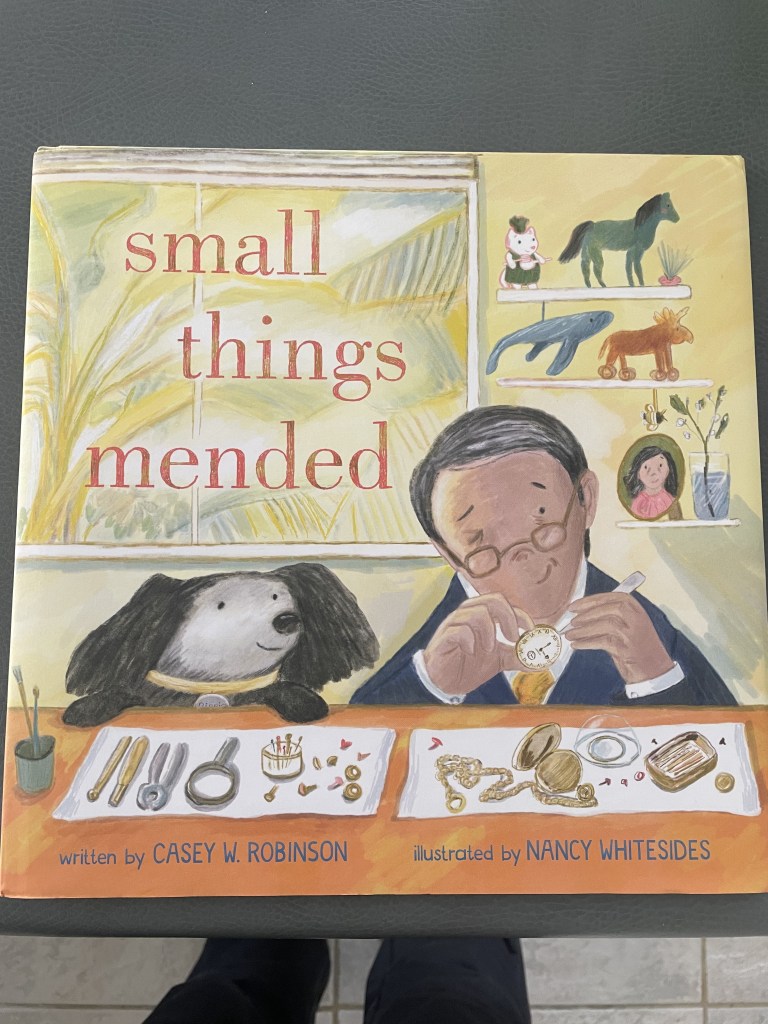
by Casey W. Robinson and Illustrated by Nancy Whitesides
Small Things Mended is one of my new favorite picture books and is the book I’d like to highlight this Valentine’s Day. I recently gave it to one of my granddaughters and I think it’s the kind of book I’d like to give even to adults in my life who give simple, but truly meaningful service to those around them. In our ever-increasingly disconnected world, these people are like the glue that holds communities together, and I love them for it. It has recently received many awards and I can easily see why. It’s such a gentle, sweet, lyrical story, with timeless themes of love, friendship, and the power of community and service. As a bonus, it is full of fun words that make for a great read aloud–words like “jaunty” or “ker-chunk,” and alliteration like “trinkets and treasures.”
The plot and characters are lovely. Cecil is an older gentleman with a bad eye, and a lonely heart. He enjoys hearing young Lily’s laughter as she cartwheels and plays, that is until her pocket watch flies out and breaks. But Cecil is a tinkerer and offers to fix it for her and in doing so remembers how much he loves fixing things, and even more so, how good it feels to give service and love. Soon other children bring him broken objects and eventually he puts up a sign: Small Things Mended. Somehow Cecil reminds me of my father-in-law who enjoyed a bit of tinkering and would rather fix things than head out to buy new stuff all the time. It’s a lost art.
Then, one day Eleanor brings him a well-loved stuffed animal elephant, named Daisy, with a missing eye button. “He needs his eye fixed,” Cecil offers. Cecil can relate with bad eyes too, but Eleanor says Daisy actually has a broken heart. “A broken heart is not a small thing,” says Cecil. “I’m not sure I have the right tools.” But he tries anyway, and in the end decides “a broken heart needs friends.” So, Cecil creates a neighborhood meal using vegetables from his neglected garden. And through that simple act, many broken hearts come away a bit more mended, especially his own. I love the wisdom and metaphors of this book, but it reads beautifully as a simple story too.
So, if you’re looking for something to give those “glue” kind of people in your life, or to inspire simple kindness and service in the children in your life, or just fill them with gentle love, this beautiful picture book might be for you. Happy Valentine’s Day! I’m feeling inspired. Maybe I’ll give some kind of simple and meaningful service with my grandchildren today. Small things do mend hearts in ways we may never know.
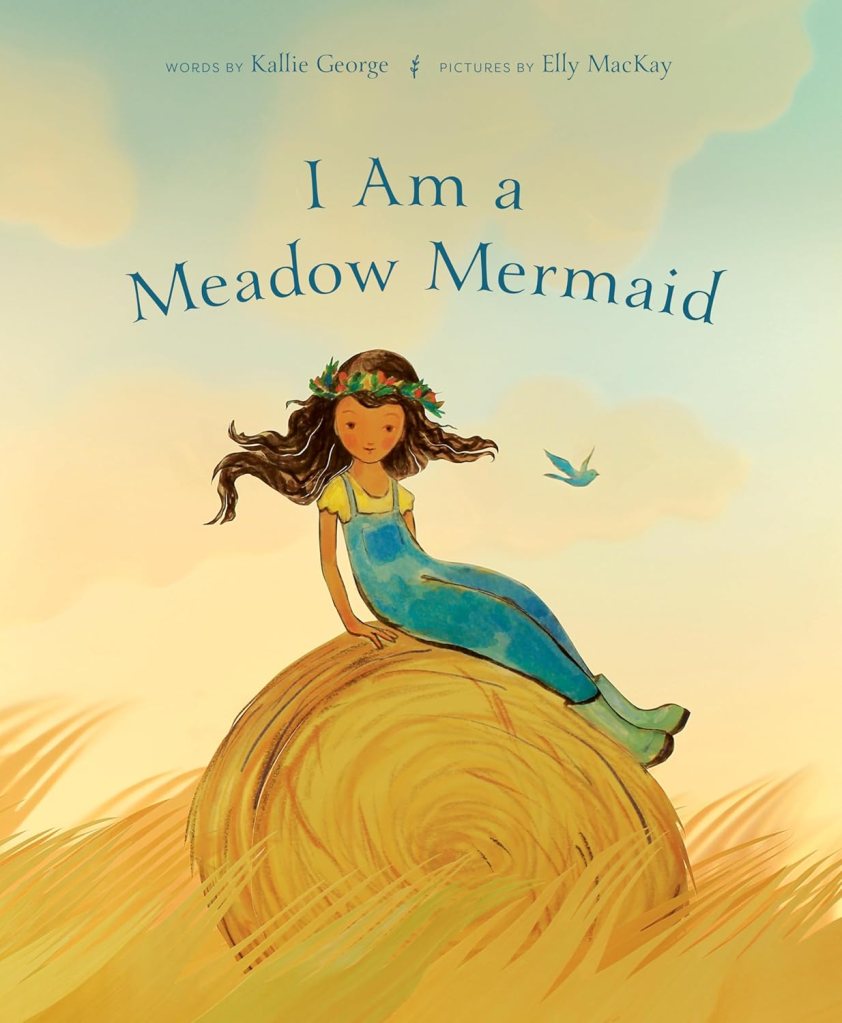
I recently read I am a Meadow Mermaid by Kallie George and illustrated by Elly MacKay with my three-year-old granddaughter. She loves all things mermaid. On a recent sun-soaked day, we went and played in a stream near her home. She quicly found a rock for her Little Mermaid moment, her chest stretching proudly to the sky, Ariel-style, ah-ah-ah’s ascending too, louder and louder. Her sisters did a show on a rock stage. We found plenty of treasures in the stream too. There is something magical about nature, imagination, and children (for adults too). We all came away happier.
I think that’s why I like Kallie’s book so much. The main character is only introduced to us as a meadow mermaid, which is just the way my granddaughter would introduce herself too, in the same situation. The main character owns her mermaid status despite her landlocked prarie home. She swims through grass, feels the wind (aka hair dryer), and dreams of water (in the sprinklers). Eventually she even saves a shipwrecked sailor (aka bike-wrecked girl), who becomes a friend, uh I mean a prarie pirate.
This book feels so true to the way younger children think and imagine, to the way they turn everything into something else. I love imagination and children, and I love how Kallie’s book captures it. Elly’s illustrations are beautiful as well. Way to go ladies!
Nonfiction writing is far more creative today than it was when I was a child. For example, Jessica Lanan, another Colorado author, wrote and illustrated the picture book JUMPER: A DAY IN THE LIFE OF A BACKYARD JUMPING SPIDER. It came out in 2023 from Roaring Book Press and has received several awards already. Instead of using expository writing (which is still useful. I use it for my educational writing all the time), Jessica used a narrative nonfiction style to engage children on a whole new level. Jessica also writes from second-person perspective to pull children in even closer. For example, it begins with “What if you were very small? Smaller than a cat or a dog, a bar of soap, or a bottle cap. As small as a bean,” with each phrase typed smaller than the last.
Jessica’s art is also engaging, with close-ups of Jumper’s world, including extended spreads of how Jumper sees his world. We have a lot of jumping spiders in Colorado and they’re easy to take for granted, or to be annoyed by, such as when I found one on my car’s dashboard while driving recently. I had to pull over to avoid driving spider-distracted. But after reading this, jumping spiders look and sound so amazing, part of me wanted to see if I could jump as far as a jumping spider. I wouldn’t be surprised to see my grandchildren jumping from couch to couch yelling, “Look! I’m a jumping spider.” Even better, hopefully they’ll go outside and try to find one. That’s my preferred place to observe them. There’s something about being in nature with kids that creates calm and curiousity. It’s one of my favorite summertime pastimes.
I too enjoy writing narrative nonfiction. It’s so fun! So, if it’s been a while since you picked up a nonfiction picture book, maybe go check a one of the many new narrative nonfiction ones. You don’t even have to have a child to enjoy them! Jessica Lanan’s JUMPER would be a good one to start with.
by Gregory Maguire. Illustrated by David Litchfield
216 pages
middle grade: ages 8-12
One of my all-time favorite activities is to read with my family. Over the years we’ve established the bedtime habit. Today, my youngest is fourteen, and we’re still reading before family prayer many nights. I love that our children now read to their children as part of their bedtime routine. Books can do so much. They bring us together to laugh, discuss, and cry, away from screens for a bit. And story is also a powerful teacher–subtle and nuanced.
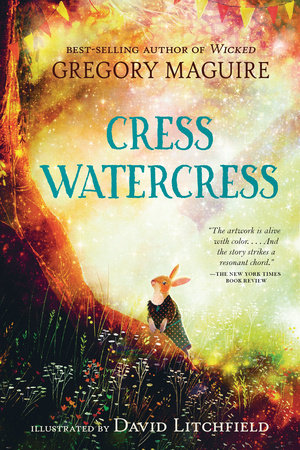
I recently got some of my grandchildren the book CRESS WATERCRESS by Gregory Maguire and illustrated by David Litchfield. Candlewick Press published it in 2022. It is a middle-grade book, for ages 8-12. However, it has short chapters and so is also a good read-aloud that even my three and five-year-old grandchildren enjoy.
It also deals with death and grief with gentleness, wisdom, and making the most of difficult situations, where, as Mama says: “We don’t have the privilege of choice.” For this reason, I also just bought it for my sister’s young kids, who lost their father early in the pandemic (he was scheduled for his first immunization the week after he got it). It would also be a sweet story for refugee children, or others living in a new situation.
For example, Mama has a sweet reply to a worried Cress, who is coming to accept that Papa might be forever gone, just like the moon. “Ah, said Mama. I see. But my darling Cress, the moon will grow back. It comes and goes, just like grief. It waxes and wanes-those are words for how the moon grows and then diminishes, melts away. Over and over. It always comes back. It’s part of life. You get used to it. You learn you can live through the moonless nights.” Cress does indeed learn to accept and grow through her grief.
It’s a delightful, whimsical story about Cress, a young rabbit, with a baby brother Kip, who has a bad case of asthma, and an overwhelmed Mama. Mama has already accepted that Papa is dead, but Cress is holding out, hoping against hope. As the older sister she tries to pick up the slack for Mama, but it’s hard. They must move to a new home at the base of Broken Arms, which is an old tree, with an old owl “owner,” who charges the steep price of 10 moths a night for rent. It is also full of other interesting residents, such as the “nutty” Oakleaf squirrel family, Manny Mouse and his wife, and some vigilant songbirds who “moan in falling tones.” Their community is also full of interesting antagonists like Lady Agatha Cabbage, with a chinchilla for a lorgnette around her neck and a certain brand of perfume (ie skunk smell), and Tuck the Bear.
Mr. Owl is full of bravado but harbors his own secret “broken arms” vulnerability. It’s made him insecure and lonely, something that Cress will take a risk to help him with in the end. Only Manny Mouse knows the truth about Mr. Owl, and shares it only on a “need-to-know basis.” But what can Manny do but tell Cress? Cress has caught on, and she cares.
Gregory Maguire is a great writer. The book is full of delightful lyrical language, such as Kip being grumpy, i.e. “all sour milk on salty soap.” It is also insightful. Insecure Owl tries to intimidate by letting everyone know he hears everything they might say about him. “I hear you down there. Make a note of it.”
I also had a flashback to a grade-school moment when Cress is trying to figure out how to belong with her squirrel friends who are having a bean bag fight, but don’t hit her because they don’t know her well enough yet. She’s not sure she wants to be hit but weirdly feels left out.
The book has a classic feel to me. The themes are powerful: death, insecurity; friendship, and finding out who you are in the face of adversity. Plus it’s super entertaining and fun! I applaud Gregory!
A while back a friend at church told a story over the pulpit that gave me the galloping giggles. He told about a trip his big family took when he was a child. They were traveling along in their Volkswagen van with its rubber floor when someone spilled soda pop on the floor. When the driver took a turn, it ran all over the van floor. The result: everyone’s feet stuck to the floor the rest of the trip, even after trying to wash it. (Parenting tip: When you say your prayers tonight, thank God for modern spill-proof cups. Also, soda pop in the car is a bad, bad idea. You will also have to stop at every rest stop all the way to your destination).
Everyone in the congregation laughed at his story, but unlike everyone else, I couldn’t stop, even after his talk turned more serious. (Tip for kids: if you get the giggles in such a situation, think of something serious, fast. An upcoming homework assignment is a safe bet.)
Its just that I could relate so much to both the messiness and joys of big family attempts at fun and work. It’s good stuff. Hard stuff. Bonding stuff.
When I grew up, my large family didn’t have a VW bus. My parents ran a candy vending business, so we had a cargo van with only a driver’s and passenger seat and no side windows. We’d all lay in the back on long trips, never totally sure where we were. Thank goodness for books. And yup, it was still capable of the same sticky floor situation. My family learned to laugh so we wouldn’t cry. The advantage of that is that we’re still laughing together today. We all make memories working hard and traveling with our families despite the fact that plans rarely turn out how we hope they will.
And don’t even get me started on the pandemonium of trying to get a big family cleaned up for something important. That’s a story for another day. (Big family tip: Give yourself twice the amount of time to get ready that you think you need. And if you get there and discover you daughter has no underwear on under that dress, just laugh and enjoy the wedding, or whatever).
This might be why I like the picture book BATHE THE CAT by Alice B. McGinty and Illustrated by David Roberts. This diverse family is trying to get ready for Grandma Marge’s coming and the house is a mess! Dad assigns chores, using the refrigerator magnets, including his chore, which is to bathe the cat. The cat is not at all pleased about getting bathed, and comes up with a clever plan to change the refrigerator magnets around. Soon family members are feeding the floor, rocking the rug, and scrubbing the fish. Hilarious slap-stick, kid-like comedy ensues.
Like I say, in all families, but especially big ones, a sense of humor goes a long way.

 Jenny Crooks-Johnson